Core memory

Detail of a 64*64 cores matrix. The core diameter is 0.1". Each core is traversed by four wires. Twelve of these planes were stacked in a memory system of Ferroxcube Inc. The stack was contained in a heavy 19" rack-mount box, together with power supply and driver electronics.
Around 1950, memory was implemented by mercury and nickel-wire delay lines, magnetic drums and 'Williams tubes'. The invention of core memory in 1949 was a leap forward in cost-effectiveness and reliability; it is generally ascribed to A. Wang and J.W. Forrester [5].
Core memory was used first in the Whirlwind computer [4] besides Williams tubes. The first commercial computer with a core memory (100.000 bits, cycle time 17 μs) was the IBM 705, a vacuum tube based computer delivered in 1955. In 1976, 95% of all computer main memories consisted of ferrite cores, 20-30 billion of which were yearly produced worldwide [1]. The price per bit of core memory was 20 dollarcent in 1960 and decreased from there with 19% per year. In 1974 was the 'turn-over' to semiconductor (transistor) memory with the advent of the 4 kbit chip; the cost was 1 cent per bit for both techniques by then.
For almost 15 years, 'core' has been the most important memory device. Core memory has been in use until the turn of the century for special purposes, because it retains the information when the power is switched off, and it is resistant against radiation.
The physical basis of core memory is the fact that a current sent along a wire passing through a ferrite core sets a persisting core magnetization, if the current exceeds a certain threshold. A current in the opposite direction will reverse the direction of the magnetization. In this event a voltage pulse will be induced in another wire threaded through the core, the 'sense wire'; the polarity of this pulse is determined by the original magnetization direction. Clearly reading is a destructive operation, and as part of the read cycle the original state of each core must be restored.
Core memories were often organized as a planar matrix, the 'write' wire being split up into two wires (row, column) each carrying half of the threshold switching current. This made it possible to address a specific core in the matrix for reading or writing. Accordingly, this type of core memory is often referred to as 'coincident current memory'. A stack of such planar matrixes would make a 3D structure, where sophisticated access schemes were possible by threading the cores in each separate plane by up to 5 wires.
Early core memory was hand-woven, a cumbersome and therefore expensive process. In [6] is the described how core-threading was mechanized, reducing the time to thread a 64*64 plane form 25 hours to 12 minutes.
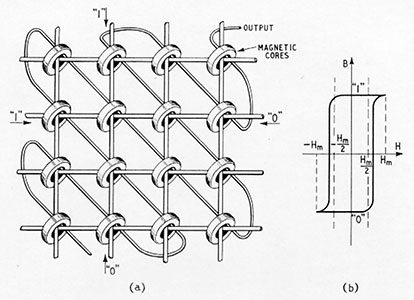
Wiring of a coincident current memory matrix (a). BH-diagram of core ferrite material (b). From [2]
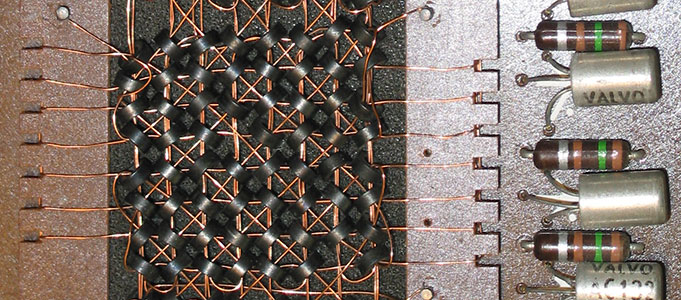
Detail of an early 320 bits hand-threaded core memory module, probably of British origin [CM 96.91].
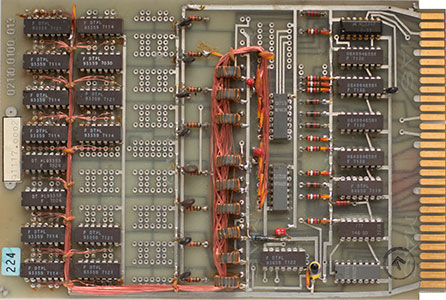
Magnetic cores were also used in a linear arrangement, in particular in smaller devices like calculators and text processors. Circuit board from Datica textprocessor (Germany ~1960) using DTL logic [CM 16.21].
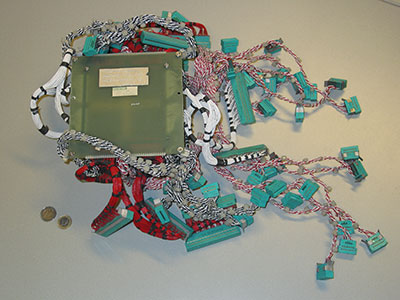
Ferroxcube brand module, 16K words (24 bits+parity bit) with associated wiring, from a GE-Bull 400 computer [CM 02.58].
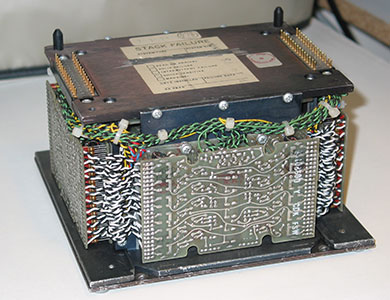
Memory stack built from 1.2 mm cores with 5 read/write
wires, used in the CDC 6000 mainframes, around 1968.
4K*12 bits, price Dfl 40.000.
About 80,000 of these compact modules (measuring
17*17*10 cm) were built by CDC.
[CM 93.05].
References:
1. Middelhoek, George and Dekker: Physics of Computer Memory Devices. Academic Press 1976.2. Ivall (ed): Electronic Computers. Iliffe London 1956.
3. MF11-U/UP core memory system maintenance manual. Digital Equipment Corporation 1973.
4. Redmond and Smith: Whirlwind, the History of a Pioneer Computer. Digital Equipment Corporation 1980.
5. Wikipedia: Magnetic core memory
6. Bashe et al: IBM's Early Computers. MIT Press 1986.
rev March 30, 2017
